How to Read a Script on Camera Without Sounding Like You Are Reading
How to write a script for speech, position a teleprompter so the eye line holds, and use the one line eye lead that makes scripted delivery sound unscripted.
How to write a script that survives being spoken, where to physically place the text, and the reading technique that separates scripted delivery which works from scripted delivery that is obvious.
Reading on camera convincingly depends on three things: a script written for speech rather than for the page, text positioned immediately beside the lens in a narrow column, and the habit of reading roughly one line ahead of your voice so you are speaking a thought rather than pronouncing words.
The useful question is not "how do I hide that I am reading?" It is "why does this sound written?" Most of the problem is in the script rather than the delivery, and no amount of performance rescues a sentence nobody would ever say out loud.
Fix the script first
Most of what people call a delivery problem is a writing problem. Written English and spoken English are different registers, and reading the first out loud always sounds like reading.
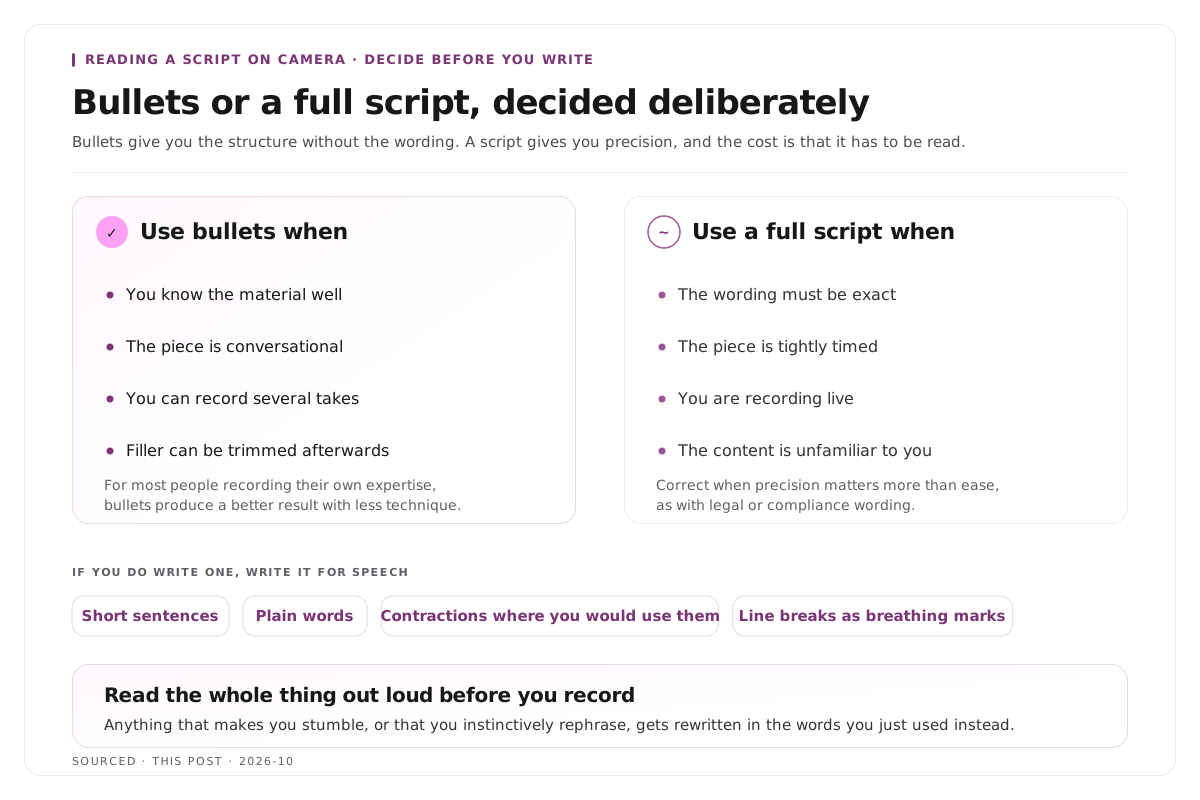
Short sentences. If a sentence needs a breath in the middle, split it. Written prose carries subordinate clauses comfortably. Speech does not.
Plain words. Use the word you would say. "Use" rather than "utilise", "about" rather than "approximately". Formal vocabulary is the clearest signal that text is being read.
Contractions where you would use them. This is the one exception to formal writing habits that matters most. People say "it is not working" far less often than the contracted form, and a script without any reads as stilted.
Line breaks as breathing marks. Break the script where you would naturally pause rather than at the width of the page. The layout becomes a performance instruction rather than just text.
No sentence you would not say. The test is simple. Read the whole thing out loud before you record. Anything that makes you stumble, or that you find yourself instinctively rephrasing, gets rewritten in the words you just used instead.
Write the opening twice as carefully as the rest. The first sentence is where a scripted delivery is most audible, because you have not warmed into it yet. It is also what decides whether anyone keeps watching, which is covered in how to write a hook for short form video.
Consider bullets instead of a full script
Worth deciding deliberately rather than defaulting to a script.
Bullets give you the structure without the wording. You know what comes next and you say it in whatever words arrive, which sounds natural automatically. The cost is more takes and more filler to cut.
A full script gives you precision and a predictable runtime. The cost is that it has to be read, which takes technique.
| Use Bullets When | Use a Full Script When |
|---|---|
| You know the material well | The wording must be exact, as with legal or compliance language |
| The piece is conversational | The piece is tightly timed |
| You can record several takes | You are recording live |
| Filler can be trimmed afterwards | The content is unfamiliar to you |
For most people recording their own expertise, bullets produce a better result with less technique. A script is the correct choice when precision matters more than ease.
Position the text properly
This is the mechanical half and it is mostly about distance.
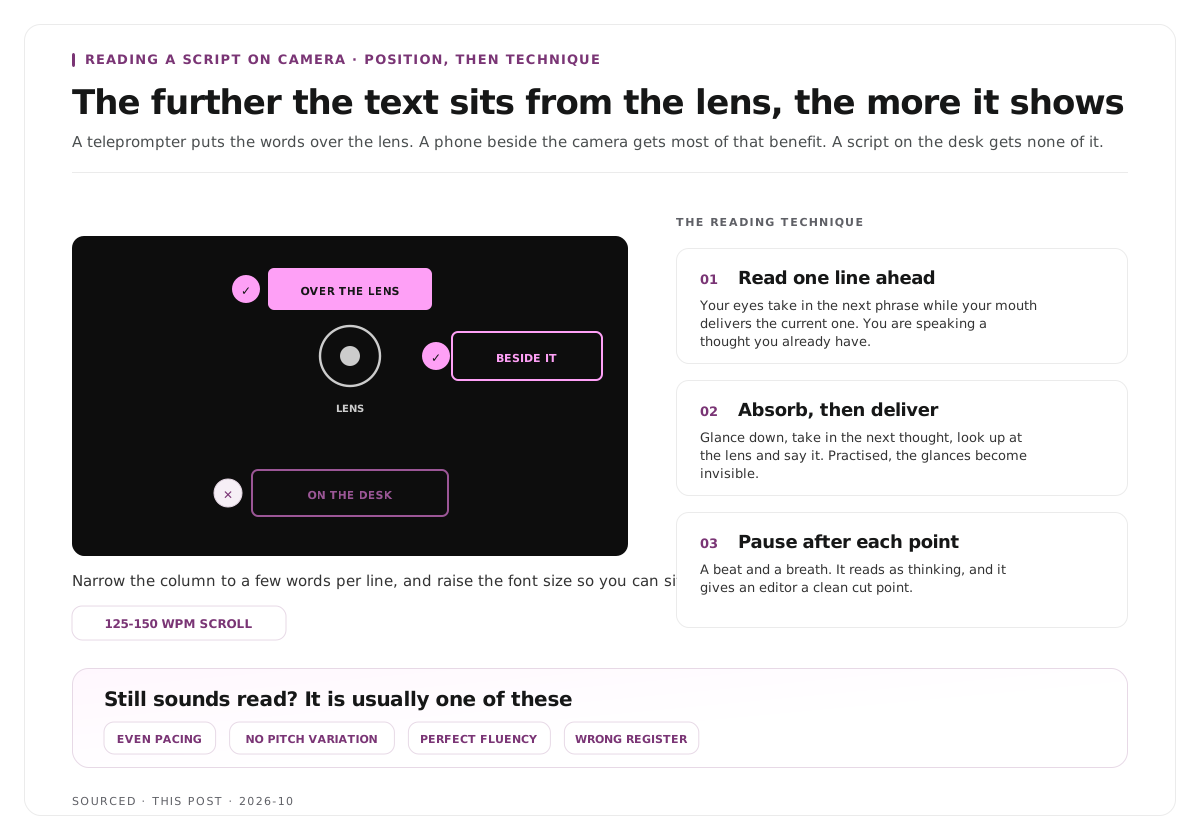
Put the text immediately beside or beneath the lens, at the same height. The further the text sits from the camera, the more your eye movement shows. A dedicated teleprompter puts the text directly over the lens, which is why it works, but a phone or tablet mounted right next to the camera gets most of the benefit.
Narrow the column to a few words per line. Wide lines force the eyes to track left to right visibly. A narrow column means the eyes barely move horizontally and the reading is almost invisible.
Increase the font size. Larger text can be read from further away, which lets you sit back far enough that small eye movements are not noticeable at all.
Match the scroll speed to your natural pace, which for most people is roughly 125 to 150 words per minute. Too fast produces a rushed, clipped delivery. Too slow produces unnatural pauses and the temptation to fill them.
Never put the script below the camera on a desk. Looking down is the single most obvious tell, and the resulting shot also shows the top of your head rather than your face. The framing consequences are covered in talking head videos.
The reading technique
Three habits separate scripted delivery that works from the kind everyone can spot.
Read one line ahead of your voice. This is the central technique and it is the thing that makes the difference. Your eyes take in the next phrase while your mouth delivers the current one, which means you are speaking a thought you already have rather than pronouncing words as they arrive. It feels unnatural for the first few attempts and becomes automatic quickly.
Absorb, then deliver. With bullets or a script beside the lens rather than over it, the pattern is: glance down, take in the next thought, look up at the lens and say it. Practised, the glances become invisible. The mistake is trying to read continuously while maintaining lens contact, which produces neither.
Pause deliberately after each point. A beat and a breath. It reads as thinking, it gives the sentence weight, and it gives an editor a clean cut point. Scripted delivery tends to run points together because the next line is already visible.
Two things also help that people underestimate. Mark the script up with your own emphasis and pause notations before recording, because reading a plain block invites a flat rhythm. And record the first page twice, since nearly everyone is stiffest in the opening thirty seconds.
When the delivery still sounds read
If you have done all of the above and it is still obvious, the cause is usually one of these.
Even pacing. Every sentence at the same speed. Real speech speeds up through setup and slows on the point. Mark two or three places in the script to deliberately slow down.
No pitch variation. A flat contour across every sentence. Reading tends to flatten intonation because the brain is busy decoding rather than meaning.
Perfect fluency. Counterintuitively, slightly too clean. Real speech contains small hesitations and self corrections, and a completely smooth delivery can read as artificial. Keeping one or two natural stumbles is sometimes better than a flawless take.
Wrong register. The script is correct English and nobody talks like that. Back to the first section.
Why this matters for clips
Scripted material cuts into short form differently from conversation, and mostly in your favour.
A scripted point is already self contained, which is the hardest property to achieve in unscripted recording. If the script was written in discrete points, each one is close to a finished clip.
Scripted delivery is consistent across takes, which makes a batch of clips feel coherent rather than variable.
The risk is flatness. A scripted piece delivered evenly produces clips that are accurate and unengaging. The pacing variation above matters more in a forty second clip than in a five minute video, because there is no surrounding context to carry it.
Writing in discrete points rather than as continuous prose is the single change that makes scripted material clip well, and it fits the batching approach in how to batch a month of clips in one afternoon.
Worked example: the same script, two setups
This is an invented example, not measured data.
A specialist records a two minute explainer from a written script.
First setup. The script is printed and lying on the desk below the laptop. Sentences average twenty eight words. They read it through in one take. The result shows them looking down and slightly away on every line, the delivery is even and flat, and it is immediately obvious that it is being read.
Second setup. The script is rewritten into short sentences with line breaks at pauses, loaded onto a phone clipped beside the lens at eye level, in a narrow column at large text. They read one line ahead, pause after each point, and record it in three takes.
Same words, roughly. The second version is not mistaken for unscripted, and it does not matter, because it no longer looks like someone reading aloud at a camera.
Where Montage fits
Montage does not write scripts, does not provide a teleprompter and has no part in delivery. Everything on this page happens before it is involved.
Where it applies is afterwards. Upload a recording, up to 20GB at 4K, and it returns a timestamped transcript alongside 8 to 10 scored clip candidates, each trimmable by editing the transcript text, with branded captions and vertical reframing applied, exporting as MP4 for social or XML, FCPXML and JSON for an editor.[1]
One detail is relevant to scripted work specifically. Because trimming happens on the transcript, keeping the third attempt at a line and deleting the first two is a text operation rather than a timeline one, which is described in text based video editing. Recording each section two or three times and selecting afterwards is considerably easier than aiming for one clean read.
To try it on one recording, use the podcast clip finder.
Limitations and troubleshooting
My eyes visibly track across the screen. The column is too wide. Narrow it to a few words per line and increase the font size.
I keep losing my place. The scroll speed does not match your pace. Set it between 125 and 150 words per minute and adjust from there.
It sounds rushed. Also scroll speed, and the absence of marked pauses. Add deliberate breaks into the script rather than trying to remember to pause.
I sound flat even though the words are right. Even pacing and flat pitch. Mark two or three places to slow down and emphasise, and record that section again.
The script is fine on the page and awkward out loud. It was written to be read rather than spoken. Read it aloud and rewrite every sentence that makes you stumble in the words you instinctively used instead.
I look like I am reading and the text is already beside the lens. You are probably reading word by word rather than a line ahead. Practise the eye lead on a throwaway recording before the real one.
Scripted clips feel lifeless compared with my unscripted ones. Likely true and it is a pacing problem rather than a scripting one. Vary the speed deliberately, because scripts flatten rhythm by default.
Frequently asked questions
How do you read a script on camera without it being obvious?
Write for speech rather than the page, place the text immediately beside the lens in a narrow column, and read roughly one line ahead of your voice so you are speaking a thought rather than pronouncing words.
What is the best teleprompter scroll speed?
Roughly 125 to 150 words per minute for most people, which matches natural speaking pace. Too fast produces a clipped delivery and too slow invites unnatural pauses.
Should you use a full script or bullet points?
Bullets for conversational material you know well, since they sound natural automatically at the cost of more takes. A full script when the wording must be exact or the runtime is tightly controlled.
Where should the script be positioned?
Immediately beside or beneath the lens at the same height, never flat on the desk below the camera. Looking down is the most obvious tell and it also produces a poor framing of your face.
Why does my scripted delivery sound flat?
Usually even pacing and unvarying pitch, because reading occupies attention that would otherwise go into expression. Mark two or three points in the script to deliberately slow down and emphasise.
How do you write a script that sounds natural?
Short sentences, plain words, contractions where you would use them, and line breaks placed where you would pause. Then read the whole thing aloud and rewrite anything that makes you stumble.
Does Montage provide a teleprompter?
No. Montage processes finished recordings into clips. Scripting, prompting and delivery all sit outside what it does.