How to Write a Hook for Short Form Video (With 20 Patterns)
How to write the first three seconds of a short video, twenty hook patterns that work, and why the on screen caption is often the real hook rather than the line.
How to build the opening three seconds of a short video, twenty patterns that reliably work, and why the first caption on screen usually does more work than the line being spoken.
A hook is the first one to three seconds of a short video, roughly the first eight to fifteen spoken words. It works when it opens a loop the viewer needs closed: a claim they want tested, a question they want answered, or a stake they cannot ignore. It fails when it spends those seconds on a greeting, a name or a preamble.
The useful question is not "how do I make this more exciting?" It is "what does the viewer not know yet that they want to know?" Excitement is a delivery problem. A hook is an information problem, and the second one is fixable in writing.
Why the first second decides everything
Nobody watching a feed is waiting patiently for context. They are deciding, continuously, whether this video deserves the next few seconds, and that decision is made before your sentence finishes.
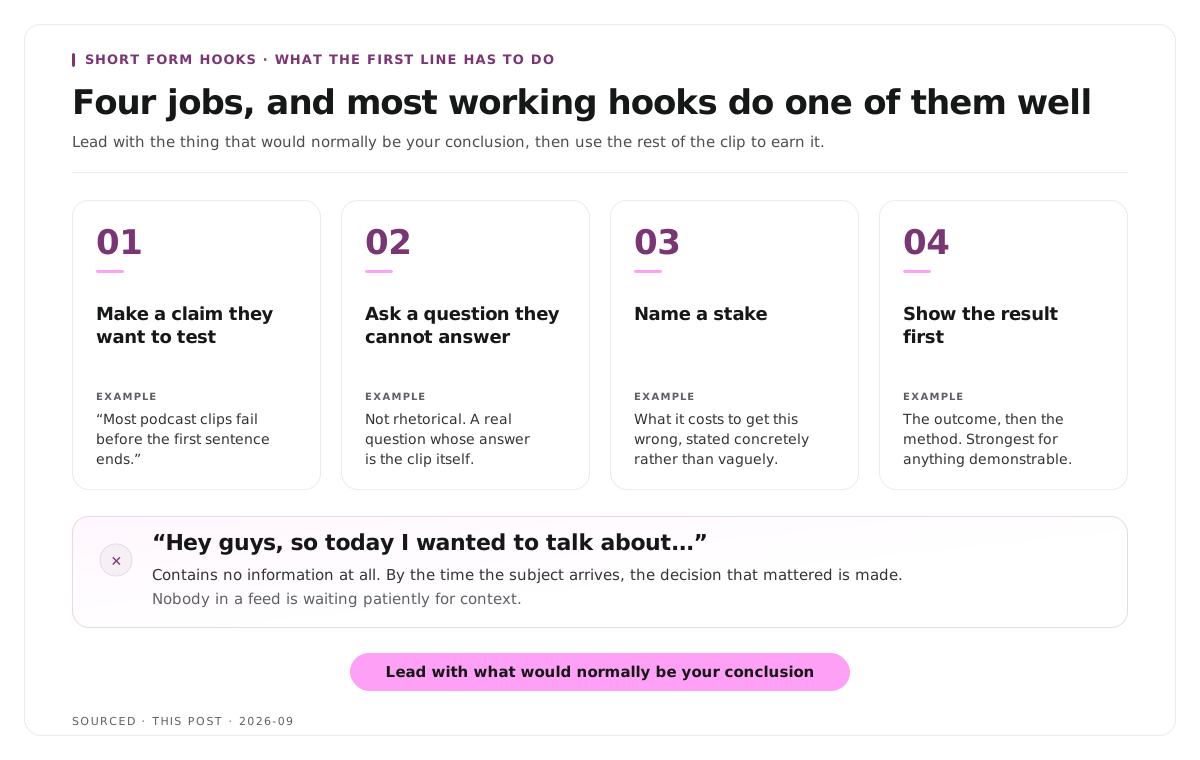
This is why the standard opening kills clips. "Hey guys, so today I wanted to talk about" contains no information at all. By the time the actual subject arrives, the viewer has already made the decision that mattered.
The fix is structural rather than stylistic. Lead with the thing that would normally be your conclusion, then use the rest of the clip to earn it.
The four things a hook can do
Every working hook is doing at least one of these. Most do one well rather than all four badly.
Make a claim the viewer wants to test. "Most podcast clips fail before the first sentence ends." The viewer either agrees and wants the reasoning, or disagrees and wants to argue.
Ask a question they cannot answer. Not a rhetorical one. A real question whose answer is the clip.
Name a stake. What it costs to get this wrong, stated concretely.
Show a result first. The outcome, then the method. Particularly strong for anything demonstrable.
20 hook patterns
Use these as structures rather than scripts. The specificity you add is what makes them work.
Claim hooks
- Most people get [X] wrong, and it is not the part you think.
- [Common advice] is technically correct and practically useless.
- The reason your [X] is not working has nothing to do with [obvious cause].
- Everybody says [X]. Everybody is wrong.
- You do not need [expensive thing] to get [result].
Question hooks
- Why does [common outcome] keep happening even when you [do the right thing]?
- What would you do if [realistic constraint]?
- How long do you think [X] actually takes?
- What is the first thing you check when [situation]?
- Do you know what happens when [specific action]?
Stakes hooks
- This mistake cost me [specific number].
- If you get this wrong, [concrete consequence].
- I spent [time] learning this so you do not have to.
- There are two ways to do this and one of them wastes [resource].
- Nobody tells you this until it is already too late.
Result first hooks
- This took [short time] and here is how.
- We went from [before number] to [after number].
- Here is the whole process in [number] steps.
- This is what [X] looks like when it works.
- Watch what happens when [action].
The pattern matters less than the specifics you put in it. "This mistake cost me a lot" is not a hook. "This mistake cost me four thousand dollars" is.
The caption is often the real hook
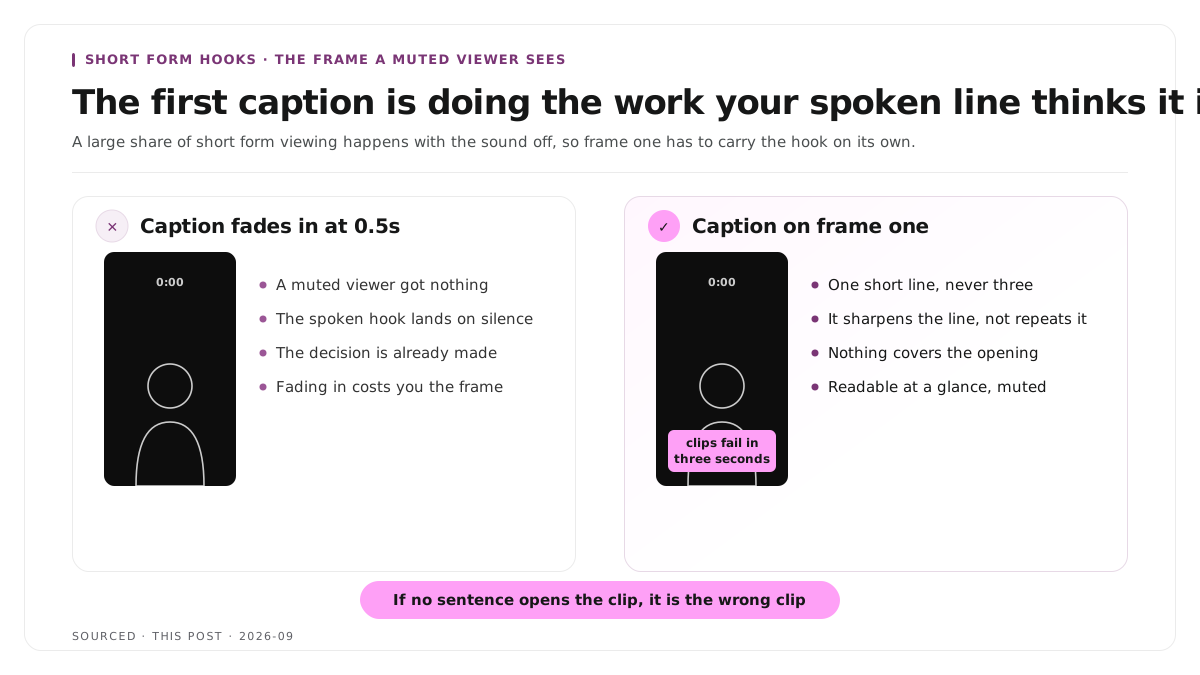
A large share of short form viewing happens with the sound off or low, which means the first words on screen are doing the work your spoken line thinks it is doing.
Put the first caption on frame one. Not faded in over half a second. If the caption appears after the hook has been spoken, a muted viewer got nothing.
Make the caption sharpen the spoken line rather than duplicate it. If you say "most people get this wrong", the caption can read "most people get this wrong" or it can read the specific thing they get wrong. The second is stronger.
Keep it to one short line. A three line caption in the opening frame is a wall, and walls get scrolled. The same rule applies to any cutaway or b-roll, which should never cover the opening.
Caption treatment across platforms is covered in caption styles for B2B and B2C platforms.
Writing hooks for clips you did not script
Most clips are cut from something longer, which means the hook already exists somewhere in the recording. The job is finding it rather than writing it.
The hook is rarely the first sentence of the answer. It is usually the second or third, once the speaker has warmed up and made the actual claim. Start the clip there and delete what came before.
Look for the sentence that contains a number or a disagreement. Those two categories produce the strongest openings and they are easy to find in a transcript.
If no sentence works as an opening, the clip is the wrong clip. This is the part people resist. A moment that needs a written hook bolted on top is usually a moment that did not stand alone in the first place.
The interview editing that surfaces those moments is in how to edit an interview video, and the selection criteria in how many clips you should make from one podcast episode.
Test the hook, not the video
Hooks are the cheapest thing in video to test, because the rest of the clip stays identical.
Film three to five hook variations in one session. Same setup, same lighting, same everything after the opening. Swapping openings later is a two minute edit.
Change one thing at a time. A different claim, or a different phrasing of the same claim, not both.
Judge on completion rate rather than views. A hook that pulls people in and loses them at four seconds is worse than one that pulls in fewer and holds them. Views measure the thumbnail equivalent; completion measures whether the promise was kept.
Keep the winners. Hooks that work tend to keep working, and a list of your own proven openings is more useful than any generic list, including this one.
If a clip runs long, YouTube now accepts Shorts of up to three minutes, so a strong hook does not have to be followed by a rushed payoff.[1]
Worked example: one answer, three openings
This is an invented example, not measured data.
A guest gives a good ninety second answer about pricing. The clip can start in three places.
Starting at the beginning gives "yeah, so, I think pricing is something a lot of founders struggle with". True, generic, and it contains no information the viewer did not already have.
Starting twelve seconds in gives "we doubled the price and churn actually went down". A claim the viewer wants to test, and it arrives in the first two seconds.
Starting thirty seconds in gives the explanation without the claim, which is the reasoning for a point nobody has heard yet. It reads as confusing rather than compelling.
Same ninety seconds, same guest, three different clips. Only one of them opens a loop, and the edit decision was where to start rather than what to write.
Where Montage fits
Montage does not write hooks, does not suggest openings and does not rewrite anything anyone said. There is no scriptwriting in it, and the judgement about which sentence opens a clip is yours.
What it does is find the candidate moments. Upload a long recording, up to 20GB at 4K, and it returns 8 to 10 scored clip candidates rather than an unranked pile, each trimmable by editing transcript text so moving the start point is a matter of deleting the sentences before it, with branded captions and vertical reframing applied, exporting as MP4 for social or XML, FCPXML and JSON for an editor.[2]
The transcript trimming is the part that matters for hooks specifically. Testing three different start points means deleting three different amounts of text rather than hunting for word boundaries in a waveform, which is described in text based video editing. To try it on a single recording, use the podcast clip finder.
Limitations and troubleshooting
The hook is strong and the clip still underperforms. The promise was not kept. A hook that overstates what follows trains people to scroll past you next time.
Every hook sounds like the last one. You are reusing one pattern. Rotate across the four types rather than staying in claims.
The opening works spoken but not on screen. The caption faded in. Put it on frame one.
There is no good sentence to start on. Usually the clip rather than the hook. Pick a different moment.
The hook needs context to make sense. Move the start point earlier until it does not, or accept that the moment belongs to the full episode.
Completion rate drops sharply at three seconds. The hook promised something the next line did not deliver. Look at sentence two, not sentence one.
Frequently asked questions
How long should a video hook be?
One to three seconds, which is roughly eight to fifteen spoken words. It is the first one or two sentences, and everything before the actual claim should be deleted.
What makes a good hook for short form video?
It opens a loop the viewer wants closed, through a claim they want to test, a real question, a concrete stake, or a result shown before the method.
Should the hook be spoken or on screen?
Both. A large share of viewing is muted, so the first caption has to appear on frame one and should sharpen the spoken line rather than repeat it.
How do you find a hook in a clip you did not script?
Look for the sentence containing a number or a disagreement, which is usually the second or third of an answer rather than the first. Start the clip there and delete what preceded it.
How do you test video hooks?
Film three to five openings in one session with everything else identical, then swap them in the edit. Judge on completion rate rather than views, because views measure the thumbnail rather than the hook.
Does Montage write hooks?
No. Montage finds candidate moments and lets you move the start point by deleting transcript text. Choosing and writing the opening remains yours.