Which Meeting Recordings to Keep, and Which to Delete
A retention policy for meeting recordings: which to keep, for how long, what to delete by default, and why recording everything creates risk rather than an archive.
A workable retention policy for meeting recordings, covering which categories are worth keeping, how long each should live, what should be deleted by default, and why an unmanaged archive is a liability rather than an asset.
Most meeting recordings should be deleted within thirty to ninety days. The small number worth keeping longer are the ones that will be reused: customer research, webinars and external sessions, training material, and anything with a contractual or regulatory requirement. Everything else is a cost and an exposure with no corresponding benefit.
The useful question is not "where should we store all this?" It is "which of these will anyone open again?" For most organisations the honest answer is under one in twenty, and building storage for the other nineteen is solving the wrong problem.
Why this becomes a problem quietly
Recording a meeting takes four clicks and is almost always the right call in the moment. Nobody decides to build an archive, and yet a team of thirty recording most of their meetings produces thousands of hours a year.
Three things accumulate alongside the files.
Storage cost, which is real but usually the least important of the three.
Discoverability collapse. A folder with forty recordings is browsable. A folder with four thousand is not, and the practical consequence is that nothing gets found, which means nothing gets used, which means the recording was pointless.
Liability. Every recording contains names, opinions, candid remarks about customers or colleagues, commercial figures and sometimes things people would not have said if they had remembered the recorder was running. Held indefinitely, that is a disclosure exposure in any dispute, an obligation under data protection regimes, and a breach risk.
The third is the one that justifies a policy. The first two merely make it annoying.
The five categories
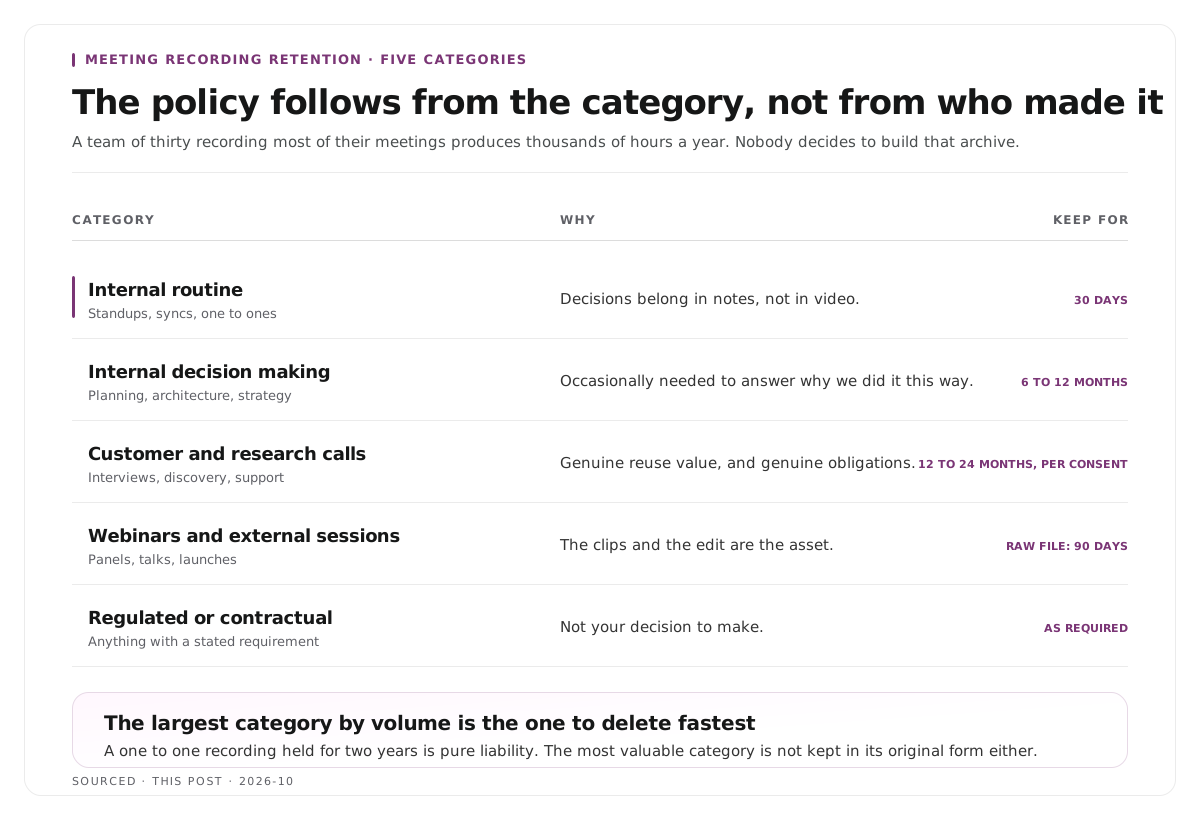
Sort every recording into one of these. The policy follows from the category rather than from who made it.
| Category | Keep For | Why |
|---|---|---|
| Internal routine (standups, syncs, one to ones) | 30 days, then delete | Decisions belong in notes, not in video. Almost never reopened |
| Internal decision making (planning, architecture, strategy) | 6 to 12 months | Occasionally needed to answer "why did we do it this way" |
| Customer and research calls | Per consent terms, often 12 to 24 months | Genuine reuse value, and genuine obligations |
| Webinars, panels, external sessions | Keep the processed output, delete the raw file after 90 days | The clips and the edit are the asset, not the source |
| Regulated or contractual | As the requirement specifies | Not your decision to make |
Two observations.
The largest category by volume is the one to delete fastest. Routine internal meetings generate most of the hours and almost none of the value. A one to one recording held for two years is pure liability.
The most valuable category is not kept in its original form. A webinar recording matters because of what you make from it. Once the clips, the transcript and the edited version exist, the ninety minute source file is rarely needed again.
What "keep" should actually mean
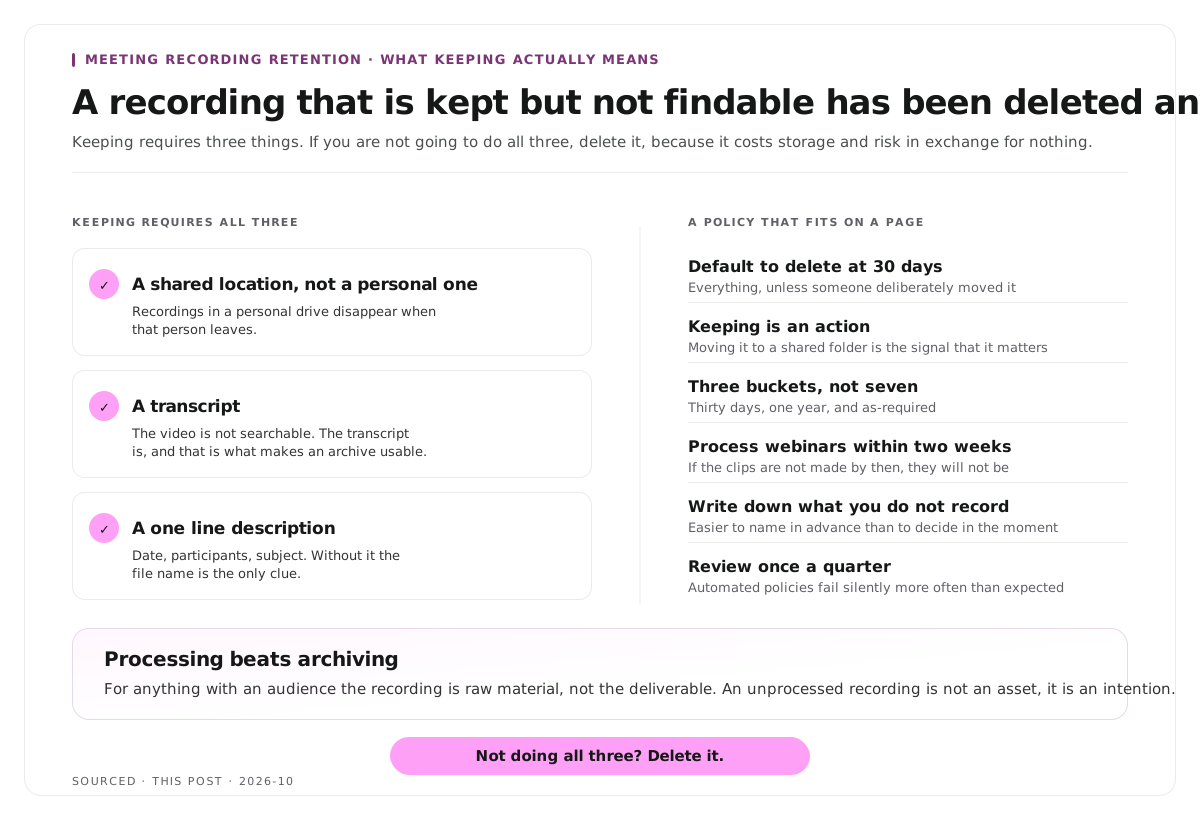
A recording that is kept but not findable has been deleted in every way that matters.
Keeping requires three things:
- A shared location, not a personal one. Recordings sitting in an individual's OneDrive or Drive disappear when that person leaves. This is the single most common failure.
- A transcript. The video is not searchable. The transcript is, and it is what makes an archive usable rather than decorative.
- A one line description of what is inside. Date, participants and subject. Without it the file name is the only clue, and file names are rarely informative.
If you are not going to do all three, delete it. A kept recording with none of them is costing you storage and risk in exchange for nothing.
The transcript point is the one that converts an archive from theoretical to actual. Reading an hour of transcript takes roughly twelve minutes against an hour of watching, and it is searchable, which the video is not.
A policy you can actually implement
Complexity is why retention policies fail. This one fits on a page.
Default to delete at 30 days. Everything, unless someone has deliberately moved it. Make the default the safe option rather than relying on people to clean up.
Keeping is an action, not an absence of action. Moving a recording to a designated shared folder is the signal that it matters. Anything left where it landed expires.
Three retention buckets, not seven. Thirty days, one year, and as-required for regulated material. More granularity than that will not be maintained.
Process webinars within two weeks. If the clips and the transcript have not been produced in a fortnight, they will not be. Delete the raw file at ninety days regardless, because an unprocessed recording is not an asset, it is an intention.
Write down what you do not record. Some conversations should not be recorded at all, and naming them in advance is easier than deciding in the moment.
Review once a quarter. Fifteen minutes checking that the deletions are actually happening. Automated policies fail silently more often than people expect.
Processing beats archiving
The reframe that makes this manageable: for anything with an audience, the recording is not the deliverable.
A ninety minute webinar is raw material. What has lasting value is the handful of moments inside it that stand alone, plus the transcript, plus whatever written content came out of it. Once those exist, the source file is a backup rather than an asset.
That is why the webinar row in the table above says to keep the processed output and delete the raw file. It inverts the usual instinct, which is to keep the source forever and process it eventually.
The practical workflow is in how to turn a webinar into 10 social clips, realistic expectations for how much a single recording yields are in how many clips you should make from one podcast episode, and the navigation layer that makes a kept recording usable is in how to create video chapters from a transcript.
For teams running this across clients rather than internally, the governance question is sharper, and the operational shape is covered in how agencies deliver client video clips faster without losing editorial control.
Consent, and why it limits retention
Consent is usually scoped, and people forget that the scope includes time.
Consent to record is not consent to retain indefinitely. Someone who agreed to a recorded research interview did not necessarily agree to that file existing in five years.
Customer and candidate recordings frequently carry contractual limits, either in your own terms or in theirs.
Data protection regimes generally require a retention period and a justification. "We kept it in case" is not a justification, and an indefinite default is the position hardest to defend.
Deletion is also an obligation, not only a courtesy. If someone asks for their data to be removed, a disorganised archive makes compliance slow and uncertain, which is itself a problem.
The practical upshot is that a short default retention is easier to defend than a long one, and far easier than no policy at all.
Worked example: two years of recordings
This is an invented example, not measured data.
A forty person company records most meetings for two years. The archive reaches several thousand files and roughly four thousand hours.
How much is reopened: a few dozen files, almost all of them customer calls and webinars.
What it costs: storage, which is modest, and a disclosure problem in a dispute, where the archive has to be searched and reviewed because it might contain relevant material. That review is expensive and it exists only because the files were kept.
What a thirty day default would have changed: the few dozen files that mattered were all identified within a fortnight of being recorded and would have been moved deliberately. Everything else would have expired without anyone noticing it was gone.
The archive did not create value. It created an obligation to search it.
Where Montage fits
Montage is not a storage, governance or compliance product. It does not manage retention, does not enforce policy, does not delete anything and has no archive features.
It addresses the processing half of the argument above. Upload a webinar, panel or presentation recording, up to 20GB at 4K, and it returns a timestamped transcript alongside 8 to 10 scored clip candidates, each trimmable by editing the transcript text, with branded captions and vertical reframing applied, exporting as MP4 for social or XML, FCPXML and JSON for an editor.[1]
The relevance is that processing a recording promptly is what makes deleting the source safe. Once the transcript and the clips exist, the ninety minute file is no longer the only copy of anything that mattered. The pipeline is explained in how AI video clipping works, and you can try it on one recording with the podcast clip finder.
Deciding what to keep and for how long is a policy question, and no tool should be making it for you.
Limitations and troubleshooting
Nobody will agree on a retention period. Start with thirty days as the default and let people argue for exceptions. Agreeing on exceptions is far easier than agreeing on a universal number.
The policy exists and is not followed. Almost always because keeping requires no action and deleting does. Invert it: default to deletion and make keeping the deliberate act.
We cannot tell what is in these files. Transcripts, retrospectively, for the ones worth keeping. For the rest, that inability is the argument for deleting them.
Someone deleted a recording that was needed. The counterpart risk, and the reason for a designated shared folder with a clear signal that a file has been promoted. Routine deletion should never touch it.
Legal asked us to preserve everything. A litigation hold overrides retention policy and that is correct. It applies to a defined scope and a defined period rather than becoming a permanent default.
The archive is in one person's personal drive. The most common and most fixable failure. Move anything kept to a shared location immediately, because personal drives follow the person.
Frequently asked questions
How long should you keep meeting recordings?
Thirty days as a default for routine internal meetings, six to twelve months for decision making discussions, and longer only for customer research, regulated material or anything with a contractual requirement.
Should you record every meeting?
No. Routine internal meetings generate most of the volume and almost none of the value, and the recordings are rarely reopened while carrying ongoing storage and disclosure exposure.
Where should meeting recordings be stored?
In a shared location rather than an individual's personal drive. Recordings left in a personal OneDrive or Google Drive become inaccessible when that person leaves the organisation.
Is it risky to keep meeting recordings indefinitely?
Yes. Recordings contain names, opinions and commercial detail, and an indefinite archive is both a disclosure exposure in disputes and difficult to defend under data protection requirements.
What makes a kept recording actually useful?
Three things: a shared location, a transcript so it is searchable, and a one line description of what it contains. Without all three, a kept recording is effectively lost.
Should you delete the raw file after making clips from a webinar?
Usually yes, after a reasonable window such as ninety days. Once the transcript, the clips and the edited version exist, the source file is a backup rather than an asset.
Does Montage manage recording retention?
No. Montage processes recordings into transcripts and clips. Storage, retention and governance remain with your own systems and policies.