How Does AI Video Clipping Actually Work?
The pipeline behind AI clip tools explained, what the scoring models actually measure, where they reliably fail, and what the score does not tell you.
The pipeline behind automatic clip tools, what the scoring models measure, the two things they do reliably and the one thing they cannot do at all.
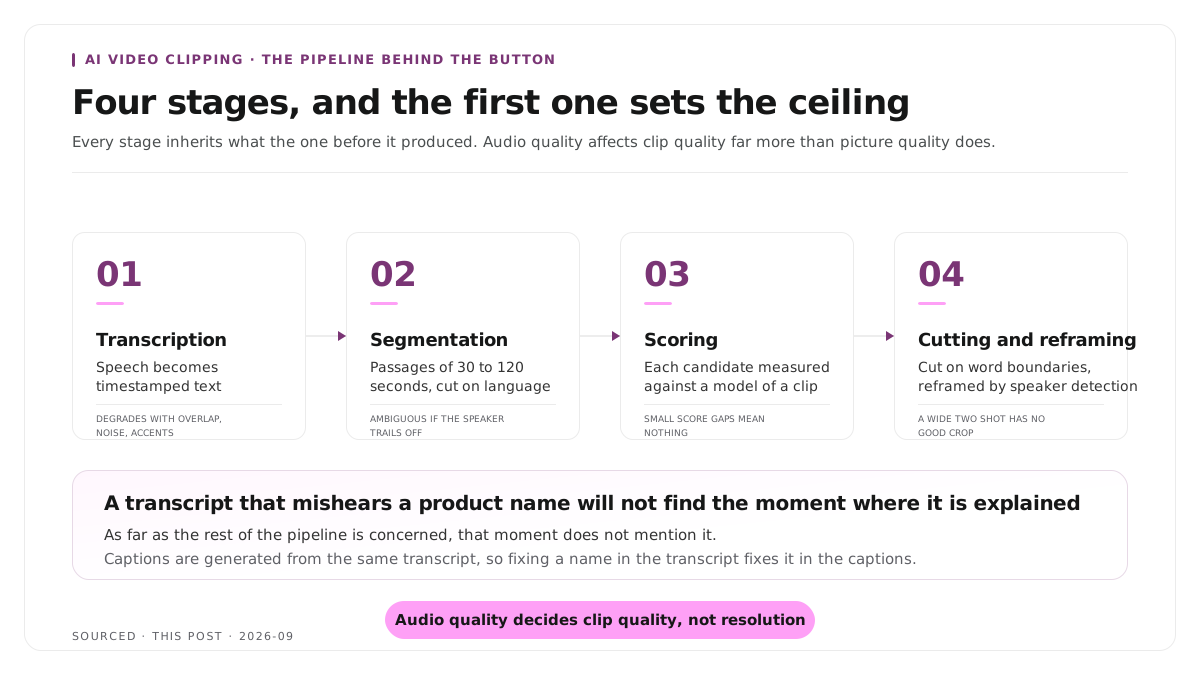
AI video clipping runs a four stage pipeline. Transcribe the audio, segment the transcript into candidate passages, score each candidate against a model of what makes a clip work, then cut and reframe the selected segments. Almost everything happens on the text, not on the picture.
The useful question is not "how accurate is the AI?" It is "what is it measuring?" These systems score properties of language, and understanding which properties explains both why they work as well as they do and where they fail in ways that look like carelessness.
Stage 1: transcription
A speech recognition model converts the audio into timestamped text. Accuracy on clean audio is high, and it degrades predictably with overlapping speakers, background noise, heavy accents and technical vocabulary.
This stage sets the ceiling for everything after it. A transcript that mishears a product name will not find the moment where that product is explained, because as far as the rest of the pipeline is concerned that moment does not mention it.
It is also why audio quality affects clip quality far more than picture quality does, which is the argument in how to edit a podcast, the audio and video workflow.
Stage 2: segmentation
The transcript is divided into candidate passages, typically in a range of about thirty to a hundred and twenty seconds.
The boundaries come from the language, not from the timeline. Topic shifts, question and answer pairs, sentence completion and pauses all signal where one passage ends and the next begins. A speaker who answers in complete thoughts produces clean boundaries. A speaker who trails between ideas produces ambiguous ones, and every downstream stage inherits that ambiguity.
Multi speaker recordings complicate this considerably, since a passage can span several speakers and cutting it at the wrong turn removes the reply that made the point land. That case is covered in how to clip multi speaker panel discussions without losing context.
Stage 3: scoring
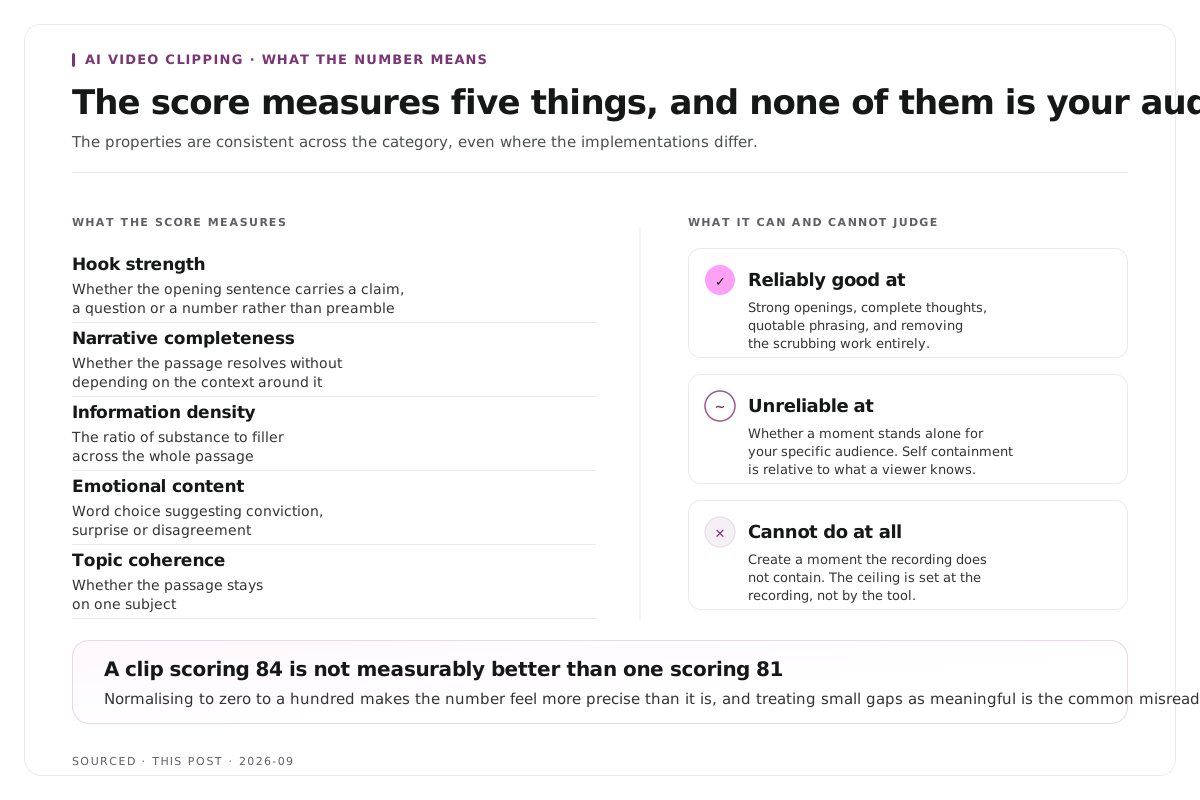
Each candidate is evaluated against a model of what makes a clip work. The properties measured are consistent across the category, even where the implementations differ.
| Property | What It Looks For |
|---|---|
| Hook strength | Whether the opening sentence contains a claim, question or number rather than a preamble |
| Narrative completeness | Whether the passage resolves without depending on surrounding context |
| Information density | Ratio of substance to filler across the passage |
| Emotional content | Word choice and sentence structure suggesting conviction, surprise or disagreement |
| Topic coherence | Whether the passage stays on one subject |
Scores are usually normalised to a familiar range, often zero to a hundred, which makes them feel more precise than they are. A clip scoring 84 is not measurably better than one scoring 81, and treating small differences as meaningful is the most common misreading of these tools.
Approaches differ in how the model is built. Some use static heuristics for virality. Others fine tune on outcome data from clips that actually performed, which tends to weight delivery quality and audience fit over raw attention grabbing.
Stage 4: cutting and reframing
The selected passages are cut at the transcript boundaries, which is why clips from these tools tend to start and end on word boundaries rather than mid syllable.
Reframing from horizontal to vertical uses speaker detection to decide what stays in frame. This is the one stage doing real computer vision work, and it is also the least reliable, because a wide two shot contains no crop that includes both faces. No model solves that, which is a framing decision made during recording rather than a processing problem.
Captions are generated from the same transcript, which means caption errors and selection errors share a cause. Fixing a name in the transcript fixes it in the captions.
What it does well and what it cannot do
Reliably good at: finding passages with strong openings, identifying complete thoughts, spotting quotable phrasing, and removing the scrubbing work. On an hour of recorded conversation this is genuinely hours saved.
Unreliable at: judging whether a moment stands alone for your specific audience. Self containment is relative to what a viewer already knows, and the model does not know your viewers. A passage that is complete for an industry audience is meaningless to a general one, and the score cannot express that.
Cannot do at all: create a moment the recording does not contain. This is the part worth being blunt about. A recording where every answer depends on the question before it has few extractable clips, and no scoring model changes that. The output ceiling is set at the recording stage, which is why how to edit an interview video matters more than the tool choice.
Worked example: two scores, one right answer
This is an invented example, not measured data.
A tool returns two candidates from the same recording.
The first scores 91. It opens with a striking claim, runs forty seconds, resolves cleanly and contains a number. By every property the model measures, it is excellent. It also states a position the company has since changed, which the model has no way of knowing.
The second scores 72. The opening is slightly slower and the phrasing is less quotable, but it explains something the audience repeatedly asks about.
The correct choice is the second one, and no adjustment to the scoring would produce that answer. The model is measuring the properties of the language. It is not measuring whether publishing the clip is a good idea.
Where Montage fits
Montage is one implementation of the pipeline on this page. It transcribes, segments, scores and cuts, and it returns a shortlist rather than a finished decision.
Upload a long recording, up to 20GB at 4K, and it returns 8 to 10 scored clip candidates rather than an unranked pile, each trimmable by editing transcript text, with branded captions and vertical reframing applied, exporting as MP4 for social or XML, FCPXML and JSON for an editor.
The design choice worth naming is the count. Returning eight to ten scored candidates rather than thirty unranked ones is a statement that the selection step is the valuable one, and that a longer list transfers work back to the person rather than removing it. It is still a shortlist for a human to approve.
Measured comparisons across the category are in the state of AI video clipping benchmark report, and to try the pipeline on one recording use the podcast clip finder.
Limitations and troubleshooting
The top scoring clip is not the best clip. Expected. The score measures language properties, not editorial judgement about your audience or your positioning.
The tool missed the obvious best moment. Check the transcript at that timestamp. If a name or term was misheard, the moment was invisible to every stage after transcription.
Clips start mid thought. The segmentation found a boundary the speaker did not intend. Move the start point back, which is a transcript edit rather than a timeline one.
Every clip needs an explainer on screen. The passages are not self contained, which is a recording problem rather than a scoring one.
Scores are all clustered together. Common on recordings with even density and no standout moments. Treat the list as unranked and choose on editorial grounds.
The vertical crop cuts someone in half. A wide two shot has no valid vertical crop. Frame speakers separately at the shoot or keep those moments horizontal.
Frequently asked questions
How does AI video clipping work?
Four stages. Speech is transcribed into timestamped text, the transcript is segmented into candidate passages, each candidate is scored against a model of what makes a clip work, and the selected passages are cut and reframed.
What does an AI clip score actually measure?
Properties of the language in the passage: hook strength in the opening sentence, whether the passage resolves without external context, information density, emotional content and topic coherence.
Is a clip scoring 90 better than one scoring 80?
Not meaningfully. The scale implies more precision than the underlying judgement has, and small differences between candidates should not decide what you publish.
Can AI tell which clip will go viral?
No. These systems measure properties correlated with clips that performed historically. They have no knowledge of your audience, your timing or your positioning.
Why did the tool miss the best moment in my recording?
Usually a transcription error. If a name or term was misheard, that passage looks different to every stage after transcription, so it was never a strong candidate.
Does Montage work differently from other AI clip tools?
It runs the same pipeline. The difference is the output shape, returning 8 to 10 scored candidates rather than thirty unranked clips, on the view that selection is the valuable step.